Quick answer
An ice maker that is not making ice is usually stopped by one of a few simple things. It may be switched off, the freezer may be too warm, water may not be reaching it, the filter may be clogged, or the fill tube may be frozen. Work through the checks below in order. Each one is safe. If every check passes and there is still no ice after a full day, a part has likely failed.
Is it normal or a problem?
No ice at all is never normal once the basics are confirmed. If the ice maker is on, the freezer is cold, and water is reaching the fridge, the machine should be making ice. A healthy ice maker fills, freezes, and dumps cubes in a steady cycle. A full day with an empty bin and no sound of a cycle running means something is wrong. Slow production can be temporary, and that part is normal. After a filter change, air in the line can slow the first batches. After a move, the freezer needs time to get back down to temperature, and the line may hold air too. Give it a full 24 hours in those cases. If production is still slow after that day, or keeps getting slower week by week, treat it as a problem and start the checks below.
Common causes at a glance
| Cause | What you will notice | How serious |
|---|---|---|
| Ice maker switched off or arm raised | No ice, no cycle sounds, everything else works | Not serious, a one minute fix |
| Freezer too warm | Soft food, slow or no ice, cubes clump in the bin | Moderate, serious if the freezer cannot hold temperature |
| Water valve partly closed or line kinked | No ice, weak or no water at the dispenser | Not serious if it is just the valve or a kink |
| Clogged or overdue water filter | Slow production, then small or hollow cubes, then no ice | Not serious, a filter change usually fixes it |
| Frozen fill tube | No ice, dispenser may still work, ice lump at the mold | Moderate, safe to thaw once, a problem if it refreezes |
| Bin sensor or shutoff arm held up | Machine silent, bin only partly full, clumped ice near the top | Not serious, clear the clump and reseat the bin |
| Jammed ejector or ice stuck in the mold | Cubes frozen in the mold that never drop, clicking sounds | Moderate, stop if the jam does not clear gently |
| Failed inlet valve | Mold stays dry, sometimes a buzzing sound | Serious, a part replacement |
| Failed ice maker assembly or motor | Mold fills and freezes but never dumps, or no cycle at all | Serious, the assembly is usually replaced as a unit |
The table runs in the same order as the checks below. The top rows are free and safe to check. The bottom rows are part failures.
Safe checks to try, in order
Work through these in order, safest first. Unplug the refrigerator before you reach behind it, move it, or thaw anything near wiring. Keep water away from electrical parts.
Check 1: Make sure the ice maker is actually on
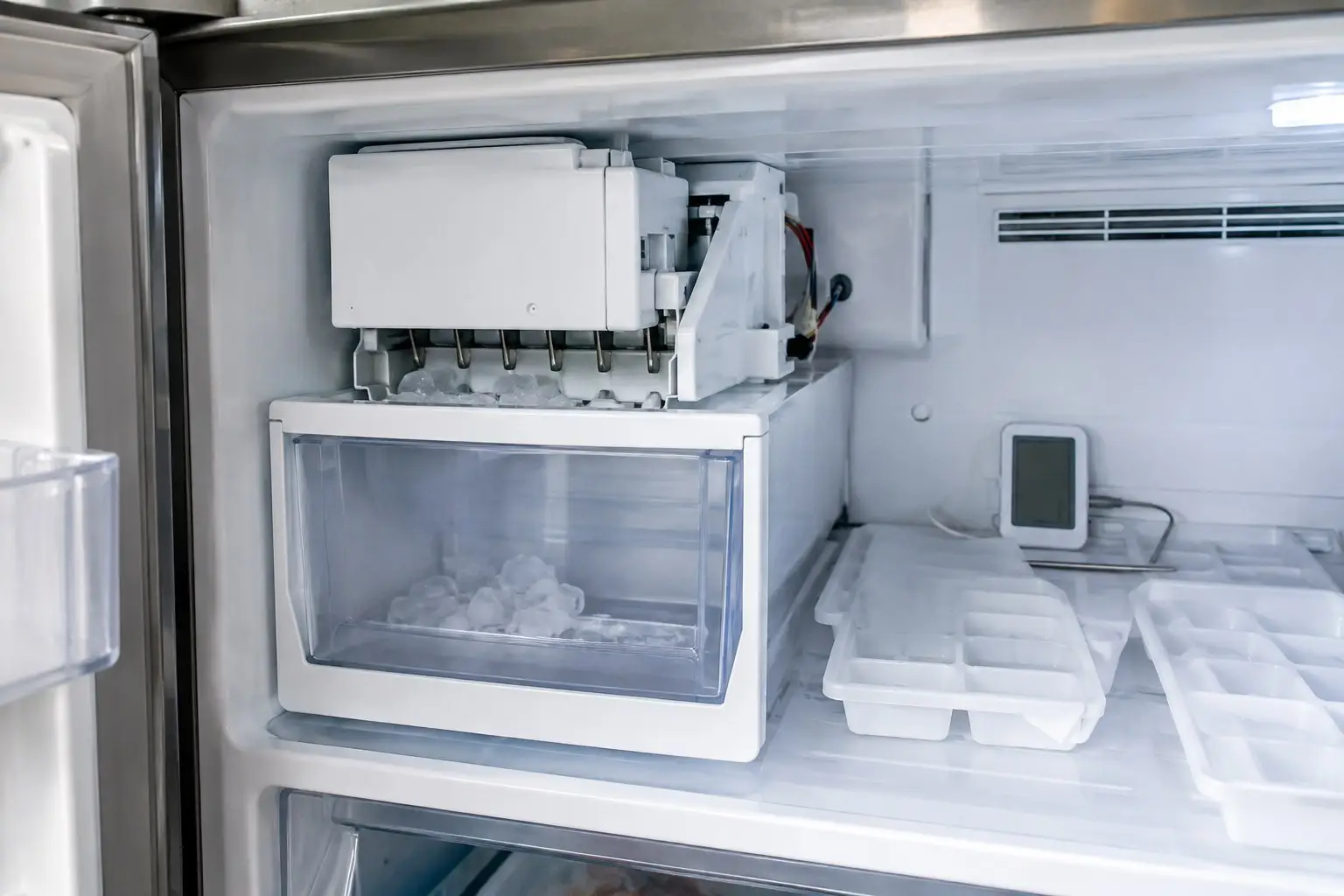
Look at the ice maker itself. Many models have a wire arm on the side. Arm up means off. Arm down means on. Others use a small switch on the unit, or an ice setting on the control panel. It is easy to bump the arm up while loading food, and a bag or box resting against it can hold it up.
Lower the arm or switch the setting back on, and move anything pressing on it. What the result means: if the arm was up, you have probably found the whole problem. Give the machine several hours, and judge it the next morning, not in an hour.
Check 2: Check the freezer temperature
An ice maker only dumps cubes once they are frozen solid, and a sensor in the mold waits for a cold enough reading first. Set the freezer to 0 degrees F. If you have a simple thermometer, leave it in the freezer for a few hours and read the real temperature, not just the setting.
What the result means: if the thermometer reads well above 0 degrees F, fix the temperature first and wait a day. If the freezer cannot hold near 0 degrees F even on its coldest setting, the problem is bigger than the ice maker. It is a cooling problem. If the freezer stays cold but the fridge side runs warm, that pattern points at airflow between the two sections, and our guide to a refrigerator not cooling but the freezer works fine explains it.
Check 3: Check the water supply

The ice maker fills from a small water line, usually tied to a shutoff valve under the sink, in the wall behind the fridge, or in the basement below it. Make sure that valve is fully open. Then, with help, pull the fridge out gently and look at the line. A line kinked or crushed when the fridge was pushed back will stop the flow cold.
What the result means: a partly closed valve, or a kink you can straighten, explains no ice with no failed parts at all. If the valve is wide open and the line looks clean and straight, supply at the wall is probably fine, and the problem sits further along the water path.
Check 4: Check the water filter
An old filter clogs slowly. Flow drops a little at a time, cubes get smaller, and one day the mold barely fills and production stops. Most makers suggest changing the filter about every six months. Make sure the new one twists or clicks fully into place, and run a few glasses of water through the dispenser to clear air and loose carbon from the new cartridge. A new filter that is not fully seated can block water completely, which is why some ice makers stop right after a filter change.
What the result means: if production comes back over the next day, the filter was the cause, and a note on the calendar for the next change will stop it happening again. An overdue filter also flattens the taste of the ice it does make, and our guide on why your ice tastes bad covers that side of it. If a fresh, well seated filter changes nothing, move on.
Check 5: Check for a frozen fill tube
The fill tube is the small tube that carries water from the back of the fridge into the ice mold. Water sitting in that tube can freeze and plug it shut. Look where the tube enters the mold area. A lump of ice at that spot is the giveaway. With the fridge unplugged and the bin out, warm that spot gently with a hair dryer on low, kept moving, or with a cloth soaked in warm water. Never chip at it with a knife or screwdriver. Cracked parts cost more than frozen ones.
What the result means: if the tube was plugged and production starts again, you are done for now, but watch it. A tube that refreezes within a few days usually means the inlet valve is leaking a slow drip that freezes overnight. Thawing it again will not fix that cause.
Check 6: Use the water dispenser as a test

If your fridge has a water dispenser in the door, use it. It shares the same supply line and filter as the ice maker, so it splits the problem in half. Fill a glass. A strong, steady stream tells you water is reaching the fridge in good shape. A weak trickle, or no water at all, tells you the problem is upstream, in the supply, the filter, or the pressure.
What the result means: dispenser weak or dry means go back to Check 3 and Check 4, because the ice maker is not getting water to begin with. Dispenser strong but the mold stays dry means the supply is fine, and the block or failure sits between the dispenser split and the mold. That means the fill tube in Check 5, the inlet valve, or the ice maker itself.
Check 7: Check the bin, the sensor, and the ice level parts
Take the bin out and look at what is in it. Ice that sits for weeks melts a little and refreezes into one solid lump. That lump can hold the shutoff arm up, block the sensor that reads the ice level, or stop the bin seating properly, and in every case the machine thinks the bin is full and stops. Some models use a sensor paddle or an infrared beam instead of an arm, and clumped ice or a frosted sensor fools those too. Dump the clumped ice, wipe the sensor area with a dry cloth, and reseat the bin flat and firm.
What the result means: if the machine starts cycling once the bin is clear and seated, old ice was the whole problem. If the bin is empty, clean and seated, and the arm or sensor still reads full, the sensor or arm assembly itself may have failed. That moves you to Check 8.
Check 8: Look for signs the assembly or valve has failed
By now you have confirmed the machine is on, the freezer is cold, water reaches the fridge, the filter is fresh, the tube is clear, and the bin is not fooling the sensor. If there is still no ice, a part has most likely failed. If the mold stays dry cycle after cycle while the dispenser works, the water inlet valve on the ice maker side has likely failed, and you may hear it buzz without water flowing. If the mold fills and freezes but the cubes never drop, the ice maker assembly or its motor has likely failed.
What the result means: this is the stop point for home checks. Valve and assembly work involves water and power connections at the back of the fridge. The honest next step is a diagnosis, not a parts order based on a guess.
What a technician does
When the checks above pass and there is still no ice, a technician works through the machine in a set order instead of swapping parts on a hunch. First, the power and control state are confirmed, so the switch, arm and sensor are ruled out first. Next, the freezer temperature is logged over time, because a freezer that drifts warm for part of the day can pass a quick thermometer check and still never finish a batch.
Then the water side gets tested. Water pressure is checked at the valve, because a valve can open and still not deliver enough water to fill the mold. The inlet valve solenoid is tested electrically, which shows whether the valve is getting its signal and whether the coil has failed. The fill tube is inspected along its length, not just at the visible end, for ice or scale further back. After that, the ice maker is run through a forced cycle test, to see whether it fills, freezes and harvests on command. Last, the sensor and shutoff arm are checked for a reading that says the bin is full when it is empty.
Each step rules out a layer, so the part that gets replaced is the part that actually failed. If your checks reached this point, that is exactly what our ice maker repair in Knoxville service covers.
What ice maker repair costs
The figures below are the same published national figures used in our cost guide. They are planning numbers, not a quote for your fridge.
- Repair of a refrigerator ice maker typically runs $100 to $300 (Angi).
- Full replacement of a refrigerator ice maker typically runs $250 to $600 installed (HomeGuide).
- A diagnostic or service call typically runs $50 to $200, and most published guides put it at $75 to $125.
Here is the honest part. No credible Knoxville-specific dataset for ice maker repair prices exists, so we use national published figures instead of inventing a local number. Your exact cost is confirmed after diagnosis, before any repair work begins. A clogged filter and a failed assembly start from the same symptom, no ice, and they do not cost the same to fix. That gap is why no honest price can be given from the symptom alone. Our full appliance repair cost guide for Knoxville shows the ranges for the other appliances too.
Repair or replace?
For the ice maker itself, repair usually wins. Most faults are a valve, a filter, a frozen tube or the assembly, and those repairs sit well below the cost of a new refrigerator.
Use the 50% rule of thumb from Angi for the bigger question. Replace the refrigerator only if the repair would cost more than 50% of the price of a comparable new fridge, and the age of the fridge and any other faults argue for it too. An ice maker fault on its own rarely meets that test. It starts to matter when the fridge is older and the ice maker fault comes on top of cooling problems or other failing parts, and the combined bill climbs toward half the cost of a new unit.
A simple way to decide: if the fridge cools well, holds temperature, and the only fault is the ice maker, repair the ice maker. If it has several faults and the total estimate passes the 50% line, put the money toward a new fridge instead.
When to stop and call
Stop the home checks and call if any of these show up:
- Water leaking inside the freezer, behind the fridge, or pooling on the floor. Turn off the water valve to the fridge first.
- Sparks, a burning smell, or a hot smell from the back of the fridge. Unplug it and call.
- The fill tube refreezes within a few days of a careful thaw.
- The mold fills and freezes but never dumps the cubes, cycle after cycle.
- The freezer cannot hold near 0 degrees F, or food in the freezer is going soft.
- You hear grinding or clicking from the ice maker that does not stop.
- Every check in this guide passes and there is still no ice after a full 24 hours.
- The fridge is under warranty. Opening it up yourself can affect the coverage, so check the terms before you take anything apart.
Knoxville Appliance Pros serves Knoxville and the surrounding area, including Farragut, Bearden, Cedar Bluff, Fountain City, Powell, Maryville, Karns, Halls, Downtown, Oak Ridge and Seymour. If your ice maker has stopped and the checks above did not bring it back, call us at (865) 290-1860, Monday to Saturday, 7:00 AM to 7:00 PM. We are closed on Sunday.

Frequently asked questions
Why is my ice maker not making ice but the water dispenser works?
If the dispenser flows well, the supply line and the filter are probably fine. The problem sits between the dispenser split and the mold. The usual causes are the ice maker being switched off, a freezer that is too warm, a frozen fill tube, clumped ice fooling the bin sensor, a failed inlet valve, or a failed assembly. Work through Check 5, Check 7 and Check 8.
How long does an ice maker take to make ice after a reset, filter change, or move?
Give it a full 24 hours for the first batch. The freezer has to reach full temperature first. If there is no ice at all after that first full day, something is still wrong.
Can a clogged water filter stop an ice maker from making ice?
Yes. A clogged filter cuts water flow a little at a time. First the cubes get small or hollow, then production slows, then the mold barely fills and it stops. A new filter that is not fully seated can block water completely.
What temperature should the freezer be for an ice maker to work?
Set the freezer to 0 degrees F. Ice makers harvest only once the cubes are frozen solid, and a mold sensor waits for a cold enough reading before it starts the cycle. A freezer running well above 0 degrees F makes ice slowly or not at all.
Why does my ice maker make small or hollow cubes?
Small or hollow cubes mean the mold did not fill fully. The usual cause is restricted water flow, from a clogged filter, a partly closed supply valve, or low water pressure. Replace the filter first and confirm the supply valve is fully open. If the cubes stay small after that, the inlet valve may be failing.
Sources
- Angi, ice maker and refrigerator repair cost guides. Source for the $100 to $300 refrigerator ice maker repair range, the $50 to $200 diagnostic and service call range with most guides at $75 to $125, and the 50% repair or replace rule of thumb.
- HomeGuide, appliance and ice maker repair cost guides. Source for the $250 to $600 installed range for full refrigerator ice maker replacement.
Cost figures are national published estimates. Your exact cost is confirmed after diagnosis.